


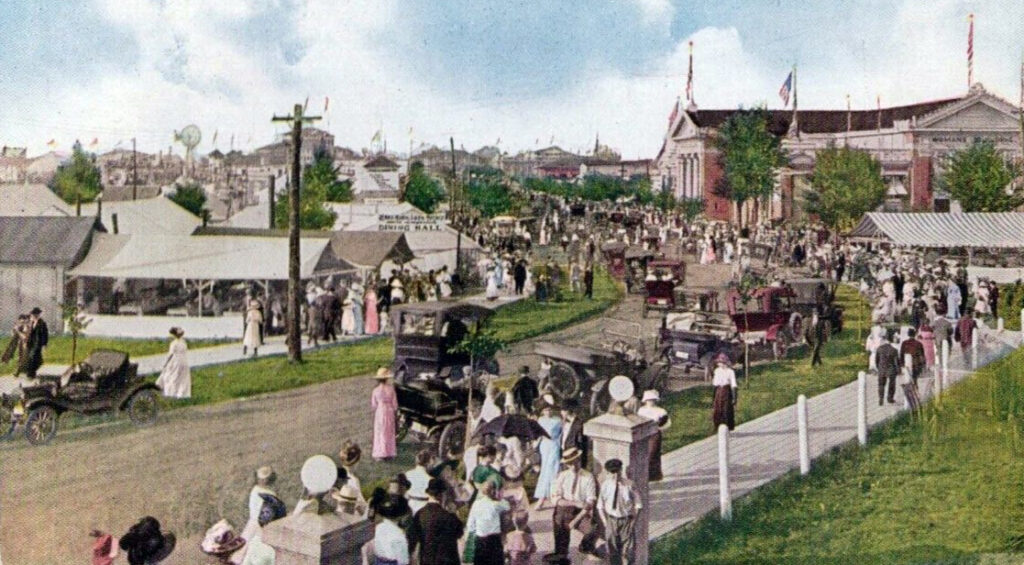
The Minnesota State Fair has been running since 1855, first held in Minneapolis before the territory even had statehood. It found its permanent home on a 210-acre Ramsey County poor farm in 1885 and has grown to 322 acres since. The character of the early fairs was agricultural — livestock competitions, farming exhibits, the business of a state built on its land. Food was always part of it, but for decades the most reliable place to sit down for a proper meal wasn’t a vendor stand. It was a church dining hall.
Church dining halls peaked in the 1950s with 26 operating across the fairgrounds, representing nearly every Christian denomination. They offered something the midway couldn’t, a table, a hot meal, and a few minutes off your feet. As the fair grew and food on a stick became its own institution, the sit-down dining halls gradually disappeared. Only two survive today.
Hamline Church Dining Hall
The oldest food concession at the Minnesota State Fair, Hamline Church Dining Hall has been feeding fairgoers since 1897, when the Hamline Methodist Episcopal Church Ladies Aid Society opened a simple stand near the bandstand to raise money for church operations. In those early years, a few homemade sandwiches and a cold drink were the entire menu, but the foot traffic was steady enough to bring in $374 that first year, the equivalent of around $14,000 today.
By the 1930s the operation had grown enough that volunteers could rest in wood-framed beds in a room behind the dining hall between shifts. The menu had grown too — ham loaf, Swedish meatballs, meatloaf with boiled potatoes, coleslaw, pie, ice cream, beet pickles, and chow mein, which was one of the most popular dishes in the 1950s. Meals were served family style for 35 cents in 1935. The dining hall established itself as a proper sit-down restaurant in 1944 when the church purchased a stand-alone building for $900. That building was replaced in 1967 with the one that stands today. Most of the recipes have always come from church members, passed down through church cookbooks and served by volunteers who keep the whole operation running each August.
Salem Lutheran Church Dining Hall
Salem Lutheran Church Dining Hall opened in 1949, a latecomer by church dining hall standards but one that carved out its own identity quickly. Unlike most dining halls that serve food cafeteria-style, Salem has always operated with volunteers taking orders and bringing food to the table — a small but meaningful distinction that gives it a different feel. Hearty breakfasts and simple lunches have been the backbone of the menu since the beginning, with recipes unchanged since 1949.
What sets Salem apart from every other food vendor at the fair, not just the dining halls, but every booth, stand, and stall on the grounds, is the Swedish egg coffee. Smooth, strong, and nicknamed the Lutheran latte, it has become the reason many people make the walk to Salem’s spot on the north side of Randall Avenue every year. More recently, the meatball sundae joined the menu and almost immediately became a fair favorite: mashed potatoes as the base, a meatball on top, gravy over everything. Simple, satisfying, and very much in the spirit of what church dining halls have always been about.
Epiphany Dining Hall
The Epiphany Dining Hall opened on the first day of the 1956 fair and ran for 45 years, using the fair as a way to fund church programs, education, and eventually a new building in Coon Rapids. The menu was familiar, baked ham, turkey, meatloaf, barbecue ribs, and homemade pie — with one memorable exception. In 1996, Epiphany introduced ostrich burgers, which stood out sharply against the comfort food landscape of the other dining halls and drew curious fairgoers who might not have stopped otherwise.
By its heyday in the 1990s, the Epiphany Dining Hall was serving over 30,000 meals during the fair’s twelve days, with more than 70 volunteers on the floor each day. A fire in 1990 caused $30,000 in damage and forced a renovation that left the church with a financial hit it never fully recovered from. As the sit-down dining trend faded and the walking food culture took over, the numbers kept dropping. The 2011 fair was the last. People came from across the Midwest for that final meal, sharing memories with longtime volunteers and saying goodbye to something that had been a fixture for half a century.
Recipes from the Dining Halls at the State Fair


Looking for a recipe?